
Boards
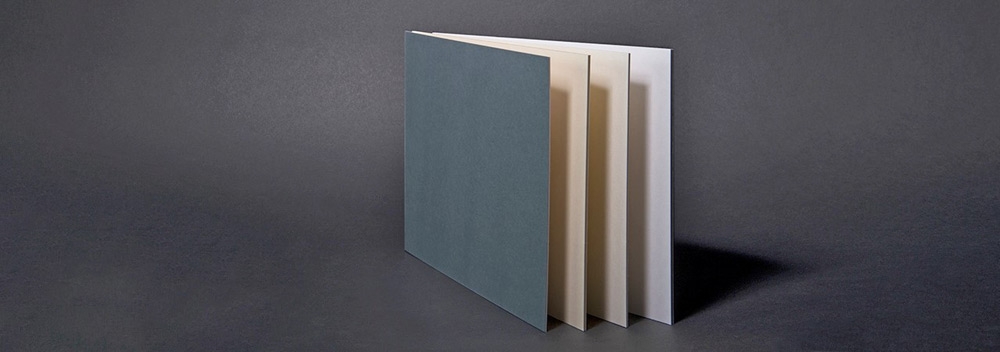
Paperboard is a flat, sheet material made essentially from fibres, predominantly of plant origin. Its basis weight starts from approx. 150 gsm. Board is a generic term that covers a range of grades and qualities of papers. The papermaker distinguishes between single-layered and multiple-layered board material. The layers are bonded together using a technique called couching (wet paper fleece is mounted together using pressure) or with an adhesive glue. Depending upon the intended use, paperboard is produced according to its preferred properties. The criteria for production may include flatness, creasing ability, gap strength, bending stiffness, cutting quality, thickness/specific volume etc. All paperboard qualities made by KLUG-CONSERVATION are guaranteed to be ageing resistant according to the technological basis of the EN ISO 9706 norm.
Mounting boards
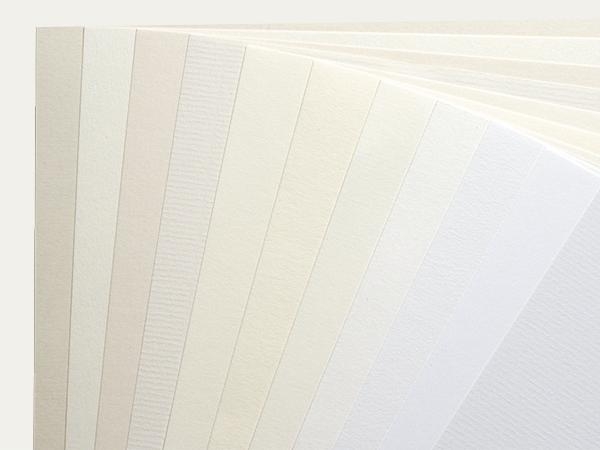
A mounting board is a flat frame surrounding a picture, which fulfils decorative or protective purposes. Mounting boards not resting directly on the original create a distance to the glass and thereby provide good protection. A shadow gap can be used to prevent development of a margin due to exposure to light. The cut-out at the same time draws attention to the original. All mounting boards by KLUG-CONSERVATION are compliant with EN ISO 9706 and offer unlimited ageing resistance.
» to the product group
Conservation boards
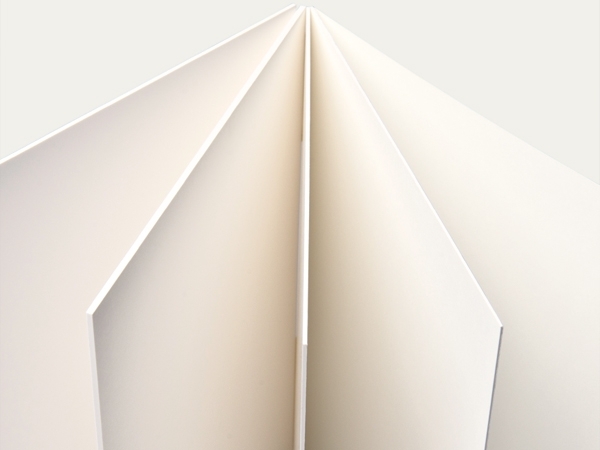
Conservation board is premium-quality mounting board composed of a number of thinner layers enhancing stiffness and planarity. Use of light-fast, water-insoluble pigments facilitates value-conserving storage and presentation. All our conservation boards meet the technological requirements of EN ISO 9706 and the material specifications of ISO 16245. KLUG-CONSERVATION is moreover the first supplier of emission-free conservation boards in the world (marked as ES products).
» to the product group
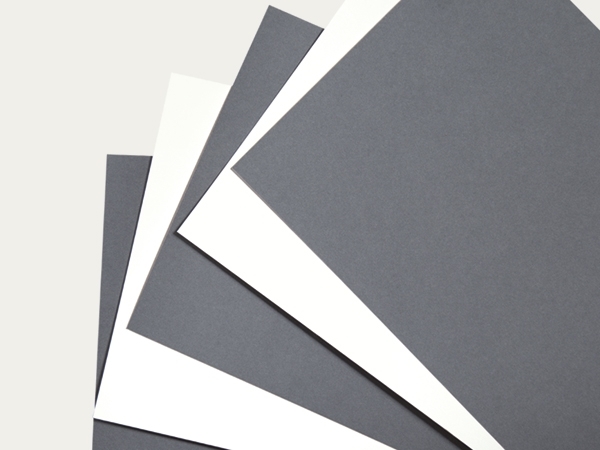
Backing boards
Backing boards for conservation-quality picture framing should be selected carefully, since placement of the original on the backboard leads to maximum possible contact. Apart from backing boards made of solid board, KLUG-CONSERVATION offers backing boards composed of single-/ multi-ply corrugated boards as well as of honeycomb panels. Backing boards should be ageing resistant and offer low/zero emission. Backing boards made of secondary raw materials, synthetic materials or wood pulp are not suitable for use in conservation-quality picture framing.
» to the product group
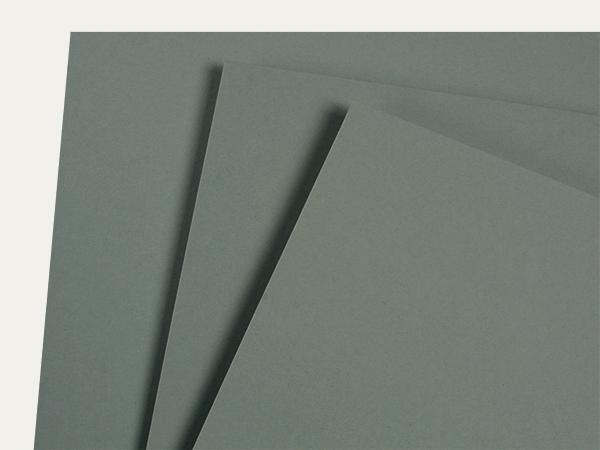
Archival boards
Ageing-resistant KLUG archival board is specifically developed to fulfil processing and long-term archiving requirements. Paper technologists at KLUG customize boards for specialists to allow them achieve optimal results when processing the material to folders, envelopes or boxes. Depending on the intended use, boards may be smooth, erasable, dyed throughout, with top surface finish, dirt resistant, resistant to dry wiping, with very good creasing properties through a higher content of long fibres and without optical brightening agents. Thicker boards may however also possess a soft core in order to obtain good creasing results.
» to the product group
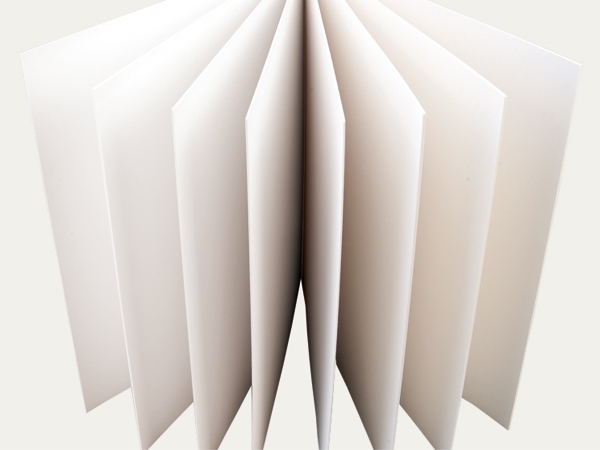
Photographic archival boards
Normally the difference between photographic archival board and conventional archival board is the lack of alkaline buffer. This board is generally dyed natural white throughout, without optical brightening agents and with a pH of 7.0. Boards without alkaline buffer are generally used in direct contact with photographic layers. All KLUG-CONSERVATION boards, as well as the majority of other products of the company, have passed the Photographic Activity Test (PAT) compliant to ISO 18916.
» to the product group
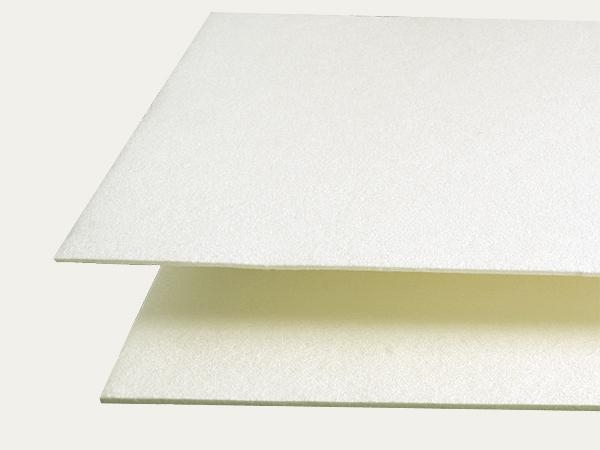
Blotting boards
Blotting board is a neutral, soft, unglued, minimally pressed, highly absorbent, acid-free board without optical brightening agents. It consists of a high proportion of cotton fibres. Thanks to the open capillaries of blotting board, fluids can be absorbed very quickly and effectively. KLUG-CONSERVATION blotting boards offer a particularly high capillary rise of over 150 ml in 10 min. When treated appropriately, blotting boards can be used for many processing cycles in restoration processes.
» to the product group
Ageing-resistant cardboard from KLUG-CONSERVATION
KLUG-CONSERVATION develops acid-free cardboard specifically for conservation applications in archiving, framing, restoration and further processing. All cardboard grades are acid-free and ageing-resistant in accordance with DIN EN ISO 9706 and designed for long-term material stability. This makes them particularly suitable for use in sensitive environments such as museums, archives and professional conservation.
Cardboard is a flat material based on plant fibres. It starts at a basis weight of approx. 150 g/m² and encompasses numerous grades for different applications. Depending on its structure, a distinction is made between single-ply and multi-ply cardboard. The layers are bonded either mechanically through felting or using suitable adhesives.
What types of cardboard are there?
Not all cardboard is the same. Depending on the intended use, the structure, material properties and processing differ significantly.
At KLUG-CONSERVATION, we distinguish between the following types of cardboard: Each of these types fulfils a specific function within collection conservation and presentation.
- Mat board: For conservation framing
- Museum board: For maximum stability and to meet museum requirements
- Backing board: As a direct support surface within frames
- Archival board: For further processing and long-term archiving
- Photographic archival board: For direct contact with photographic materials
- Neutralisation board: For restoration and conservation processes
Mat board – protection and presentation in framing
Mat board is used as an interlayer between the object and the glass. It protects the original, creates a gap between it and the glass, and enhances the visual impact of the subject. For conservation framing, ageing-resistant grades are used which comply with the requirements of DIN EN ISO 9706. Depending on the application, various colour and surface finishes are available. Of particular importance for professional processing are the excellent bevelling properties, which enable clean and precise cuts.
Museum board – maximum stability for archives and museums
Museum board is a high-quality, multi-layer board with particularly high rigidity and excellent flatness. This makes it suitable for demanding applications in museums, archives and collections. The lightfast pigments used support a long-term, value-preserving presentation of works of art, photographs and documents. Furthermore, these grades meet the requirements of DIN ISO 16245. For particularly sensitive applications, emission-free ES grades are available.
Go to the ‘Museum Cardboard’ category
Backboard – direct contact surface within the frame
Backboard forms the rear surface of a frame and often has the greatest contact with the original. The material should therefore be selected with particular care. Ageing-resistant and low-emission grades help to protect works of art, photographs and documents in the long term. In contrast, backboards made from recycled materials, plastics or wood-based materials are generally unsuitable for conservation applications. KLUG-CONSERVATION offers specially developed backing board for professional picture framing.
Go to the Backing Board category
Archival board – for folders, sleeves and boxes
Archival board is specially developed for further processing into archival folders, sleeves, boxes and other archival systems. The focus is on optimal creasing and folding properties as well as high material stability. Thanks to the high proportion of long fibres, many grades are particularly easy to process. Depending on the version, the cardboards feature finished surfaces and are stain-resistant, erasable or resistant to dry wiping. This makes them ideal for the long-term archiving of valuable collections.
Go to the ‘Archival Cardboard’ category
Photographic Archival Cardboard – for sensitive photographic materials
Photographic archive cardboard has been specially developed to meet the requirements of photographic materials. Unlike many traditional archive cardboards, it is manufactured without an alkaline buffer and has a neutral pH value of approximately 7.0. This makes it particularly suitable for direct contact with sensitive photographic layers. The grades are free from optical brighteners and have passed the Photographic Activity Test (PAT) in accordance with ISO 18916. They are frequently used for the archiving and display of photographs, negatives and other image carriers.
Go to the photographic archive board category
Blotting board – for restoration and moisture absorption
Blotting board is a highly absorbent speciality board for restoration and conservation applications. Thanks to its high cotton fibre content and open capillary structure, it can absorb liquids quickly and in a controlled manner. It is used, for example, in the treatment of historical documents, prints or other paper objects. Its high absorbency and good wet strength allow for repeated use in many restoration processes. This makes blotting board an essential tool in restoration workshops, archives and museums.
Go to the Blotting Cardboard category
What is acid-free cardboard used for in heritage conservation?
Cardboard plays a central role in the conservation, storage, presentation and restoration of cultural heritage.
Typical applications include:
- Archiving of documents and photographs
- Conservation framing of works of art
- the production of portfolios, sleeves and boxes
- museum displays and storage
- restoration work on paper
What should you look out for when choosing cardboard?
The following criteria are crucial for the long-term preservation of sensitive materials:
- Ageing resistance in accordance with DIN EN ISO 9706
- Absence of optical brighteners
- Suitable material thickness and stiffness
- Defined creasing and folding properties
- Tested material purity (PAT test)
Are you looking for the right cardboard or, specifically, a cardboard box for your application? Please use our contact form; we’ll be happy to advise you personally and help you select the appropriate grade.
