
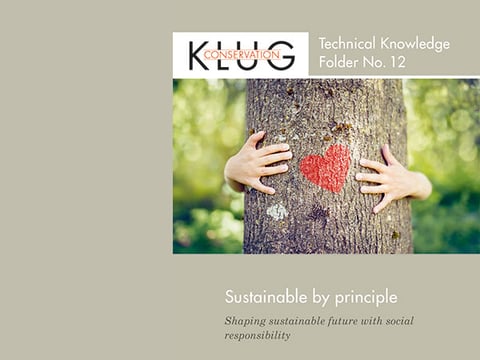
 Technical Knowledge No. 12 – SustainabilitySustainability at KLUG-CONSERVATION is more than just a goal – it is part of our corporate philosophy. People and the environment are at the heart of all our decisions. We manufacture in a resource-saving and energy-efficient way, rely on 100% FSC®-certified virgin fibre pulp, and recycle production waste by type. Our commitment goes beyond production: we support charitable projects, cultural institutions, and are part of the Climate-Neutral Allgaeu Alliance. By 2030 we aim to operate climate-neutral.
Read more in » Technical Knowledge Folder No. 12 (PDF)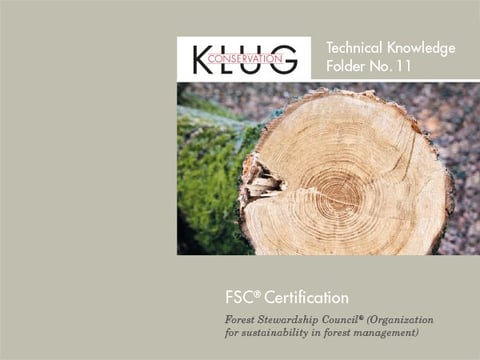
Technical Knowledge No. 11 – FSC® Certification
Since May 2021 KLUG-CONSERVATION products are FSC-certified. (Forest Stewardship Council). Our paper and board products are manufactured from 100% FSC-certified fresh cellulose fibre. As a manufacturer and retailer of FSC-certified paper products, Walter Klug GmbH & Co. KG holds a Chain of Custody (CoC) certification. This verifies that the entire path of the product – from forest to finished goods – is FSC-certified and trackable.Read more in » Technical Knowledge Folder No. 11 (PDF)
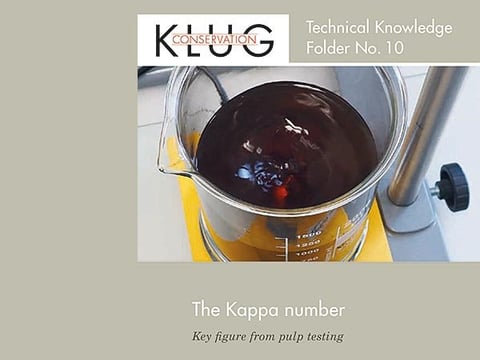 Technical Knowledge Folder No. 10 – The Kappa number
The »Kappa number» is a characteristic figure obtained from pulp testing. It is used to determine the residual lignin content in mechanically or chemically treated fibre pulp. Materials for permanent preservation must comply with the technological principles of the EN ISO 9706 and ISO 16245 Type A standards. In point 5.4 of the standard EN ISO 9706, reference is made to "oxidation resistance": "The paper must have a Kappa number below 5.0, measured as described in ISO 302, with the modifications specified in Annex A of this international standard."
Read more in » Technical Knowledge Folder No. 10 (PDF)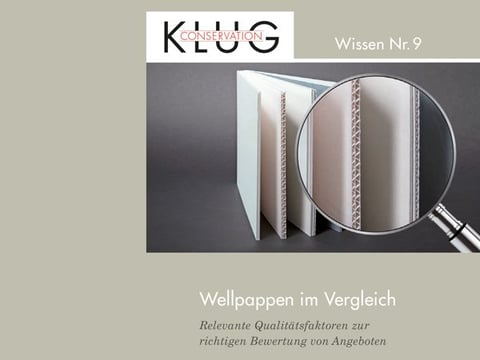
Technical Knowledge Folder No. 9 – Comparing corrugated boards
When comparing the offers supplied from different manufacturers, the questions that arise are: how can one compare the prices of corrugated board materials in relation to their composition, which criteria determine the quality of corrugated board and which quality features should be taken into consideration for the correct evaluation of offers. Read more in » Technical Knowledge Folder No. 9 (PDF)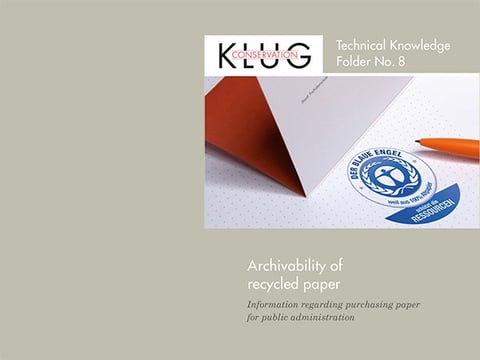 Technical Knowledge No. 8 – Archivability of recycling papers – Information regarding purchasing paper for public administration
The only way to prevent the quantity of unique cultural heritage requiring deacidification from increasing further relentlessly is for the public administration to consistently use ageing-resistant papers conforming to EN ISO 9706. Recycled paper that does not fulfil this standard may only be used by administrative bodies or associated organisation units if the papers do not have to be archived. The most effective ecological contribution is of course sparing use of paper at all levels!Read more in » Technical Knowledge Folder No. 8 (PDF)
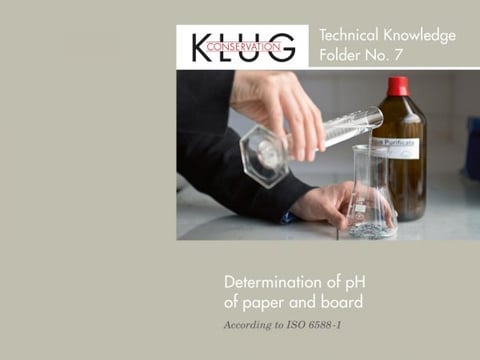 Technical Knowledge No. 7 – Determination of pH of paper and board – according to ISO 6588-1
A simple pH measurement neither allows the determination of the presence of an adequate quantity of alkaline filler in paper or board nor the assessment of compliance with EN ISO 9706.Read more in » Technical Knowledge Folder No. 7 (PDF)
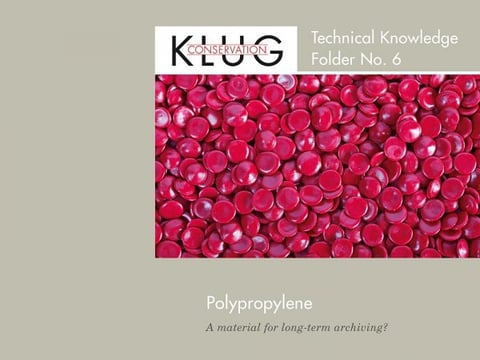 Technical Knowledge No. 6 "Polypropylene – A material for long-term archiving?"
Read more about the interview held with Prof. Dr. Gerhard Banik regarding the implementation of polypropylene boxes in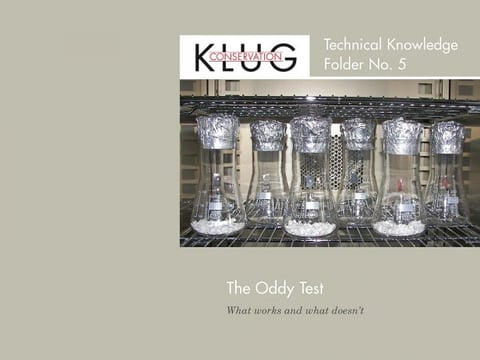 Technical Knowledge No. 5 – The Oddy test – What works and what doesn’t
Time and again we receive anxious inquires regarding the significance of the Oddy test results. The Oddy test is used to roughly estimate the suitability of materials used in display cases, cabinets, museum showrooms and packaging.
Read more in » Technical Knowledge Folder No. 5 (PDF)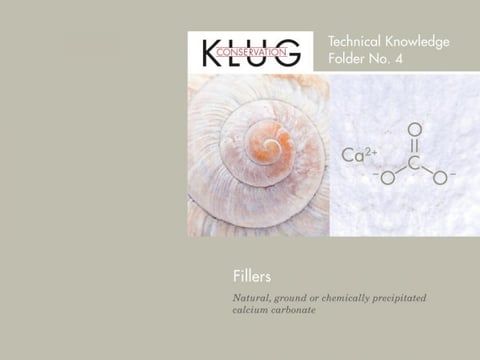 Technical Knowledge No. 4 – Fillers
Natural, ground or precipitated calcium carbonate. Which filler is better and more suitable?
Read more in » Technical Knowledge Folder No. 4 (PDF)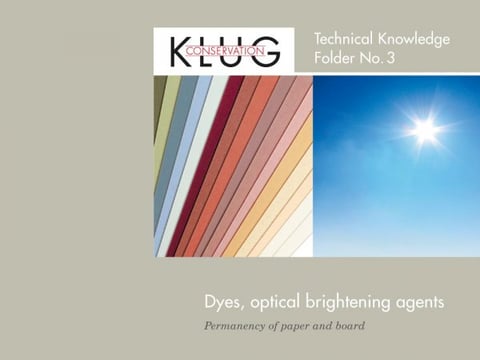 Technical Knowledge No. 3 – Dyes and optical brightening agents
Influence of dyes and optical brightening agents on the permanency of paper and board materials.
» Technical Knowledge Folder No. 3 (PDF)
» Info sheet (PDF)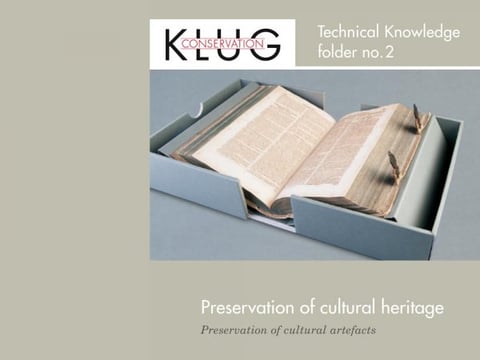 Technical Knowledge No. 2 – Preservation of cultural heritage
Ageing of paper and the necessary material requirements for protective packagings to prevent premature paper decay.
» Technical Knowledge Folder No. 2 (PDF)
» Info sheet (PDF)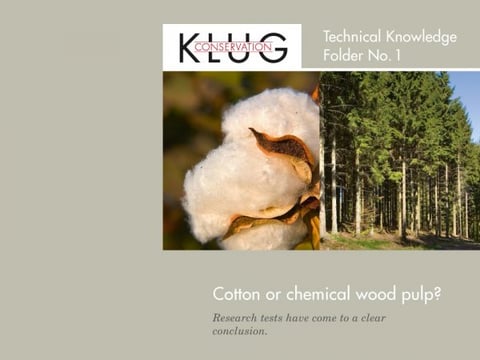 Technical Knowledge No. 1 – Cotton or chemical wood pulp?
The use of cotton pulp for long-term archiving purposes. Is the distinctively expensive cotton pulp actually more suitable for preservation purposes in comparison to chemical wood pulp?
» Technical Knowledge Folder No. 1 (PDF)
» Info sheet (PDF)
» PTS report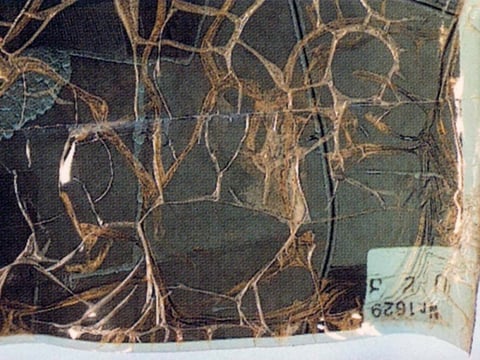
Archiving, Preservation, Conservation – Dealing with photographs
Author: Ulrike Müller, Dresden, 2005.
» Information sheet (PDF) A preservation solution for the "Incunabula from Mainz"
Description of a preservation solution
» more information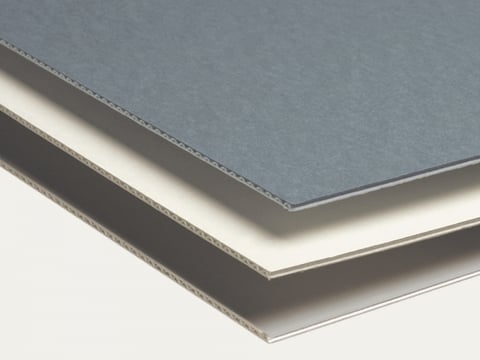 Corrugated board
In 1990, KLUG-CONSERVATION was the first company in Europe to offer ageing-resistant corrugated board that was compliant with ISO 9706. At that time, such boards were imported from the US by container ship. Since then, KLUG-CONSERVATION has established itself as the world global leader for ageing-resistant corrugated board. Find out more about the process of this development over the past 30 years.
» General information (PDF)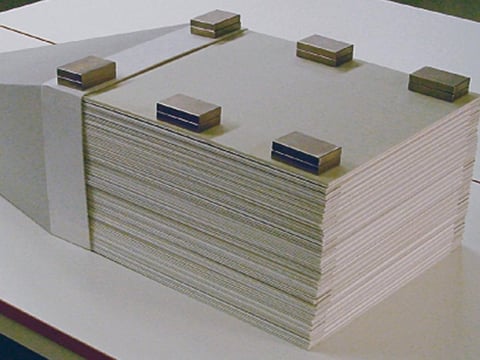 Air-stream drying of paper
Drying paper is one of the most important operations in paper conservation. Airflow drying has originally been applied in printmaking and hand papermaking workshops in order to shorten drying times and maintaining planarity of paper.
» General information (PDF)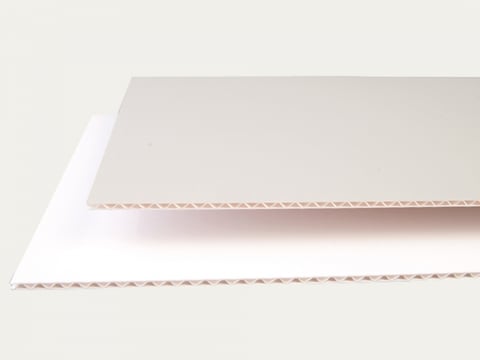 Corrugated board and their self-generated pollution emissions
The project „Pollution in museums“ undertaken by the Fraunhofer Institute Wilhelm-Klauditz in Braunschweig, tested among various other materials also the KLUG-CONSERVATION corrugated board in relation to their self-generated polluting emissions.
» General information (PDF)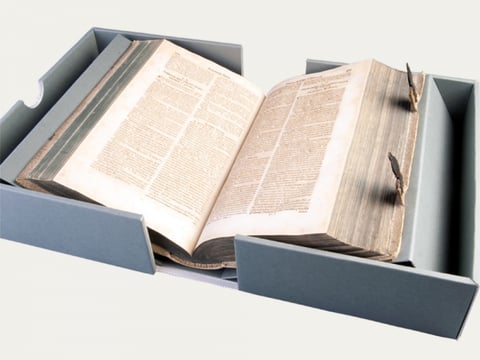 Protective enclosures for art on paper, archives and library materials
Today, it is generally acknowledged that art on paper as well as archive and library materials should be stored in protective enclosures. These enclosures should mechanically protect the objects during transportation, prevent the deposition of dust and dirt and should provide basic protection against floods and fire at least to some extent.
» General information (PDF)


